
How much does Christmas light installation cost in Vancouver, WA?
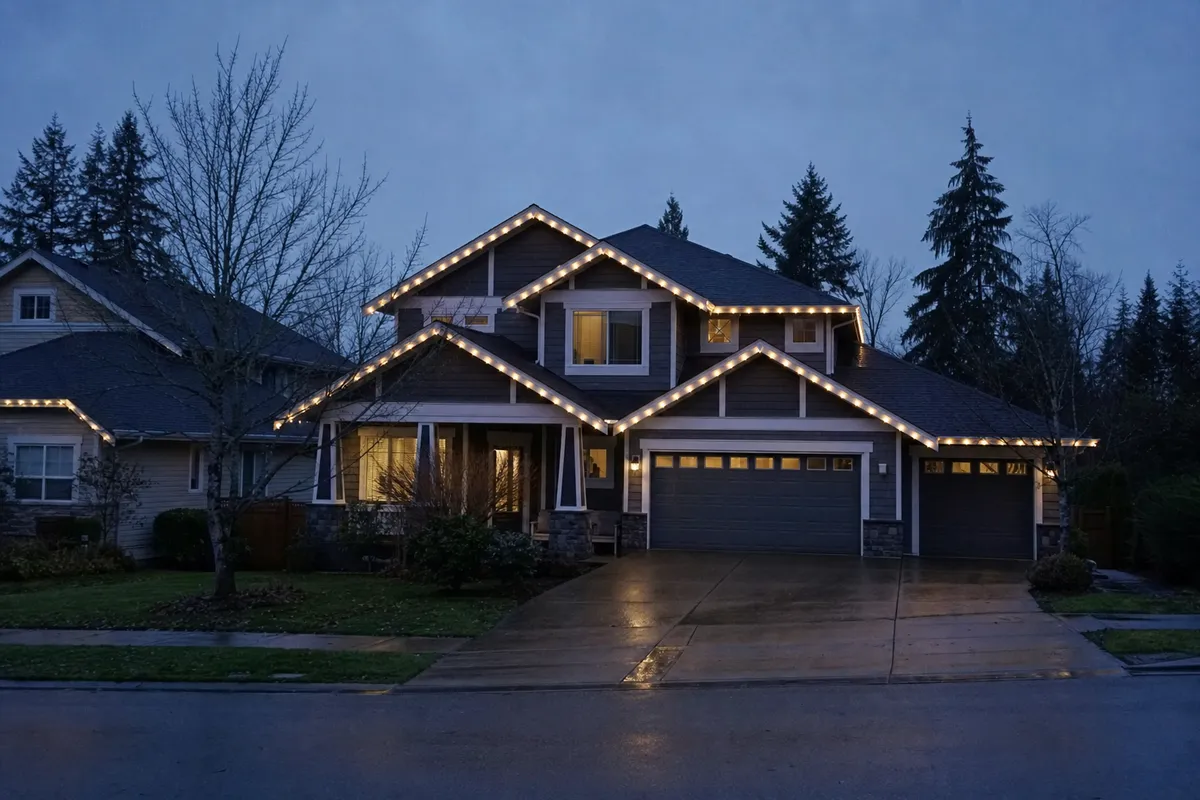
Almost nobody publishes holiday lighting prices. You call, you get a “we’d need to come out and look at it,” and three days later a number arrives with no explanation of how it was reached.
Here is the number, and here is how it is reached.
The short answer
We price by the linear foot of roofline:
Linear feet × rate, plus 8% material, plus Washington sales tax stated separately.
The rate depends on when you book:
| When you book | Rate |
|---|---|
| Through September 30 | $6.50 / ft |
| October | $7.25 / ft |
| November | $7.95 / ft |
That covers the lights themselves, the installation, outdoor-rated cords, a timer, and taking everything back down in January. If a quote you are comparing does not include all five, it is not the same product.
What that works out to
| Roofline | Sept ($6.50) | Oct ($7.25) | Nov ($7.95) |
|---|---|---|---|
| 120 ft | $842 | $940 | $1,030 |
| 160 ft | $1,123 | $1,253 | $1,374 |
| 200 ft | $1,404 | $1,566 | $1,717 |
| 250 ft | $1,755 | $1,958 | $2,147 |
| 320 ft | $2,246 | $2,506 | $2,748 |
Includes the 8% material charge. Before Washington sales tax, which we always show as its own line.
Most Clark County homes fall between 120 and 250 feet of roofline. If you have no idea which you are, that is fine — it is what the photos are for.
What actually drives the price
Square footage is not the driver people assume it is, and neither is bedroom count. A 3,000 sq ft ranch with one long, clean roofline has less lit footage than an 1,800 sq ft home with four gables and a dormer. What matters is:
Linear feet of roofline
This is the biggest single factor. Installers price the run, not the house. Every foot of roofline is material plus the time to clip it.
Height and access
Single-story work is faster and safer than a steep two-story pitch. The second story is not twice the price, but it is meaningfully more, because the setup — ladder positioning, fall protection, moving everything around the house — is where the time goes.
Peaks, valleys, and detail work
Long horizontal runs are the most light per dollar you will ever buy. Every peak means a cut, a measurement, and a transition. Outlining individual windows is beautiful and is priced accordingly.
Trees, columns, and railings
Wrapping is slow. A single well-wrapped trunk can take as long as a substantial stretch of roofline. It is worth it visually — just know that it is priced separately for a reason.
Whether removal is included
Some quotes are low because takedown is a separate January invoice. Ask directly.
The quotes worth walking away from
Anyone who wants to staple or nail into your roof. This is the one that matters. Holiday lights should be hung on clips designed for the purpose — no holes, no nails, no staples. Fasteners driven through shingles or flashing create entry points for water, and around here that water has from October to May to find its way in. A $200 saving in November is not worth a leak diagnosis in February.
We repair those roofs the rest of the year. The damage is not hypothetical.
Anyone who will not put the removal date in writing. Lights left up into spring are a sign of a company that overbooked, and a strand that spends six months in UV and rain is a strand you are replacing.
Retail-strand pricing. If a quote is dramatically below everyone else’s, check what is being hung. Big-box consumer strands are not built for a full season of Pacific Northwest weather, and the failure rate shows up right around the time you most want them working.
Why booking early is literally cheaper
Most contractors tell you to book early and leave the reason vague. Ours is on the rate card above: $6.50 a foot through September, $7.95 in November. On a 200-foot roofline that is a $313 difference for making the same phone call ten weeks sooner.
The reason is not a sales tactic. Holiday lighting is one of the few trades where the calendar is a hard physical limit. There are a finite number of dry, workable days between early October and Christmas, and every installer in Clark County draws from the same pool. Early dates can be scheduled properly and worked efficiently. Late ones mean compressed routing, weather gambles, and overtime, and that costs more to deliver.
There is a second effect that costs nothing to avoid. Dates are assigned in the order deposits arrive. By the week after Thanksgiving — when most people start calling — what is left is whatever nobody else wanted. Booking in September gets you the lowest rate and the date you actually want.
We publish the ladder in advance specifically so nobody is surprised by it in November.
Getting a real number for your home
You do not need anyone in your driveway to price a roofline. Send four photos, one from each corner of your house, and any competent installer can measure it accurately from those.
That is how we do it: text us four photos, get a written estimate back the same day with the linear footage shown, and a 50% deposit reserves your install date and holds your rate. No appointment, no sales visit.