Hanging your own Christmas lights vs hiring someone: an honest comparison
We install Christmas lights for a living, so treat this with the appropriate suspicion. But we also spend the other ten months of the year repairing roofs, including roofs damaged by holiday lights, and that gives us a fairly specific view of where DIY goes wrong.
For a lot of houses, doing it yourself is genuinely the right answer. Here is how to work out whether yours is one of them.
DIY is probably the right call if
Your roofline is single-story and simple. One long run along a front eave, reachable from a step ladder with both feet well below the top. This is the scenario DIY was invented for.
You already own the ladder and know how to place it. Not “I have a ladder somewhere in the garage.” An appropriately tall one, and the habit of setting it at the right angle on level ground.
You want a modest amount of light. Outlining one eave and wrapping a porch post is an afternoon. It looks lovely. It does not need a crew.
You actually enjoy it. Some people genuinely like this. That is a real benefit and it does not show up in any cost comparison.
If those describe you, buy decent lights and enjoy it. You do not need us.
It stops making sense when
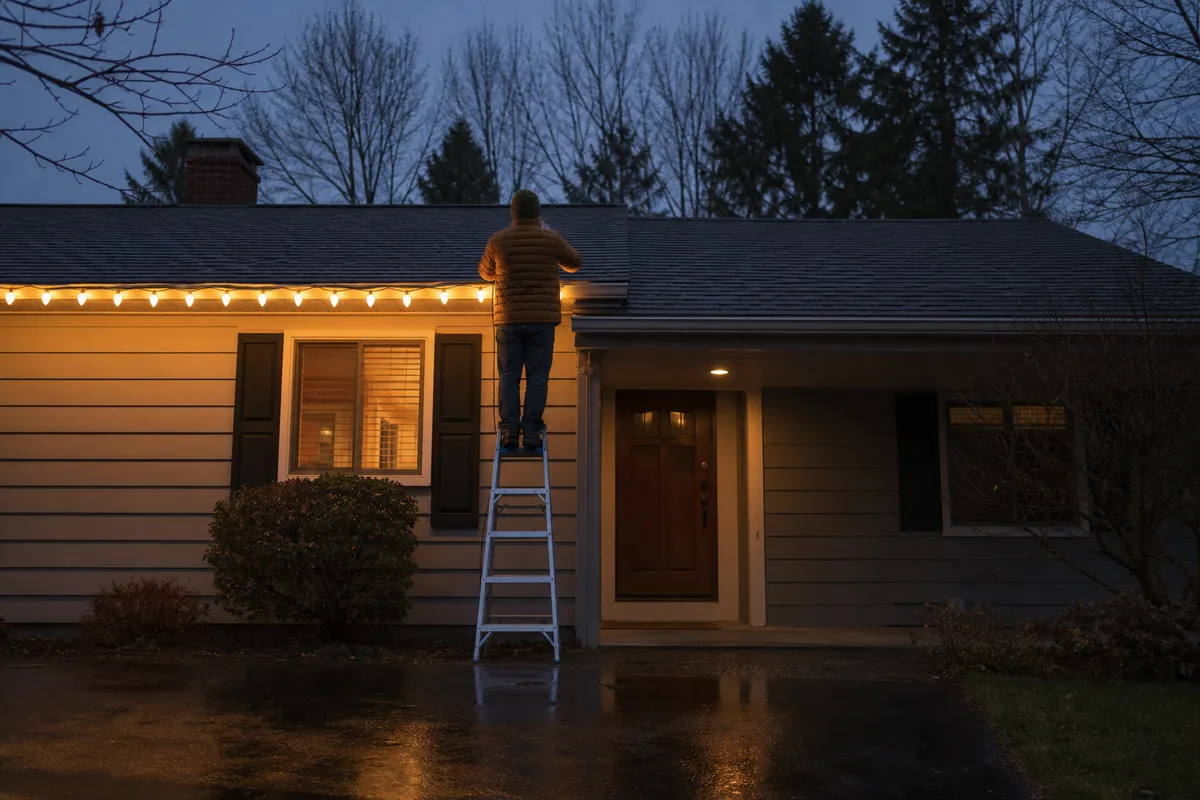
You would be working above single-story height. This is the big one. The gap between “standing on a step ladder” and “working at the eave of a two-story house” is not a difference of degree. It is a different activity, in wet PNW conditions, usually on a slope, usually alone, usually in November when it is getting dark at half four.
Your roofline is complicated. Multiple gables, dormers, changes of direction. Every transition is a measurement and a cut, and the difference between a professional-looking line and a saggy one is almost entirely in those transitions. This is why a Camas hillside house takes so much longer than a Battle Ground ranch.
You want it to look like the houses you have been admiring. Those are almost always straight, evenly spaced, consistently coloured commercial-grade runs. That look is achievable DIY, but it takes considerably more time and better materials than most people budget for.
The costs people forget
On the DIY side
The lights are the part everyone prices. The rest:
- Clips matched to your roof edge. Shingle clips, gutter clips, and ridge clips are different products. Using the wrong one is where “the lights fell down in the first wind” comes from.
- Outdoor-rated extension cords and a timer. Indoor cords outside are a genuine hazard, not a technicality.
- Storage. Lights thrown in a bin in January are lights you are untangling or replacing next November.
- A ladder tall enough to work safely, if you do not have one.
- Your time. Two full weekend days is a realistic first-year estimate for a moderately complex house, and it is usually spread across more days than that because of weather.
- Doing it again in January. In the rain. This is the part people forget entirely, and it is the least pleasant half of the job.
On the professional side
Not everything a company quotes is the same product. Compare carefully:
- Does the price include removal, or is January a second invoice?
- Does it include the lights themselves, or are you buying those separately?
- Is there a service warranty if something fails mid-season?
- Are they hanging commercial-grade C9 or retail strands with a markup?
A quote missing any of those is not cheaper. It is smaller.
The one thing that is not a preference
Whatever you decide: nothing should be stapled or nailed to your roof.
Not to shingles, not through flashing, not into the fascia behind the gutter. Every one of those fasteners is a hole, and around here a hole made in November has from then until May to find its way into your decking. We charge considerably more to trace and repair that leak than the lights cost in the first place.
Clips exist because this is a solved problem. Use them, whoever is on the ladder.
This is also the single most useful question to ask a company you are considering. If the answer is anything other than an immediate and specific “clips, no penetrations,” keep calling.
The actual comparison
We publish our rates, so you can do the arithmetic honestly rather than guessing.
Our rate is $6.50 per linear foot booked before 30 September, plus 8% material, plus sales tax stated separately. A 160-foot roofline works out to about $1,123 — installed, powered, on a timer, taken down in January, and covered by a service warranty if a strand fails in December.
Doing that same run yourself will cost you less in year one on materials alone. That is true and we are not going to pretend otherwise. The question is what the rest of the trade is worth to you: two weekends in November, one more in January, the ladder work, the storage problem, and replacing the strands sooner because retail product does not survive many Pacific Northwest winters.
For a simple single-story run, that trade often favours DIY. For a two-story house with four gables, it very rarely does.
If you decide to hire
Send four photos, one from each corner of your home. Any competent installer can measure a roofline from those and quote it accurately without putting a salesperson in your driveway.