Why moss is the Pacific Northwest's most expensive roof problem
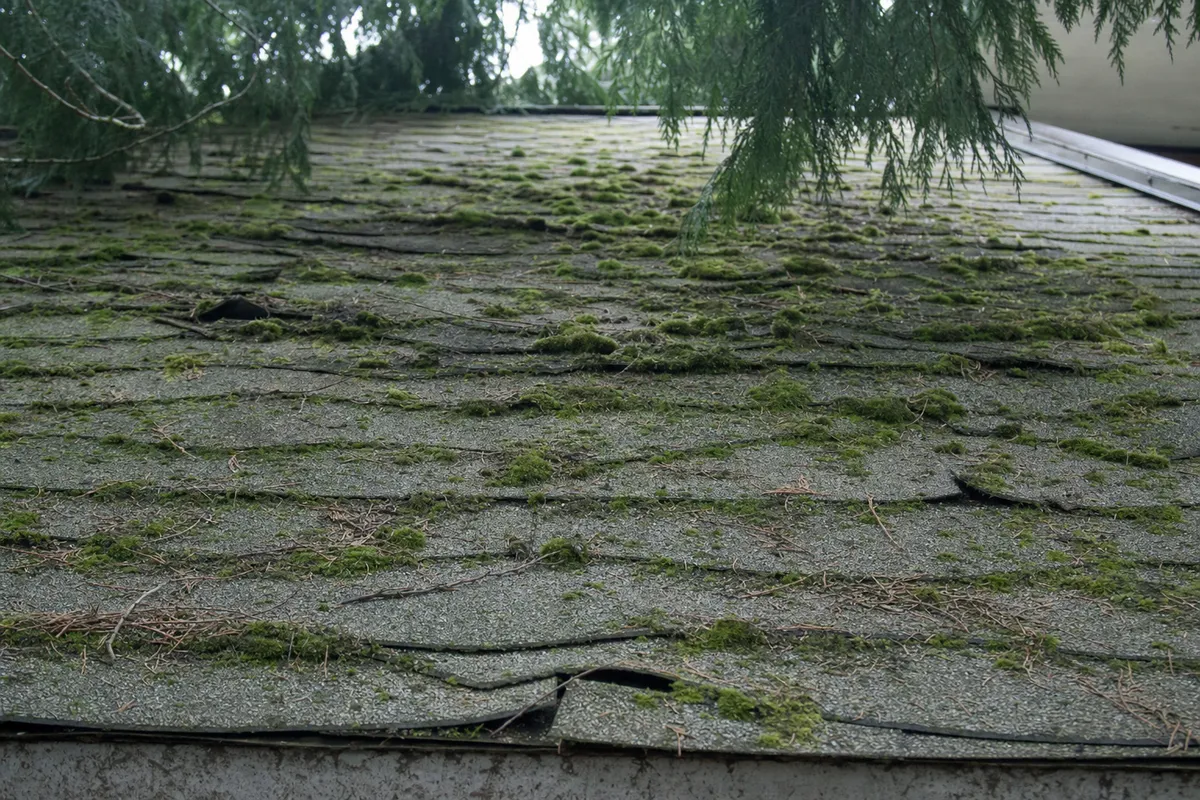
If you live around Vancouver or anywhere in southwest Washington, you have seen it: that green fuzz creeping up the north-facing slope of a roof. Most homeowners treat it as a cosmetic issue and put it off. It isn’t cosmetic, and putting it off is what makes it expensive.
What moss actually does
Moss is not a plant that sits politely on the surface. It behaves like a sponge.
Through our wet season — which runs roughly October through May — moss holds moisture against the shingle instead of letting it run off. Asphalt shingles are engineered to shed water quickly. When water sits, three things follow:
- The granules loosen. Those granules are the shingle’s UV protection. Once they wash away, the asphalt underneath degrades much faster.
- The shingle edges lift. Moss grows under the shingle edge and physically pries it up, which opens a path for water to reach the decking.
- Freeze-thaw widens the gap. We don’t get brutal winters here, but we get enough freezing nights. Water trapped under a lifted shingle expands when it freezes, and the gap gets a little bigger every time.
None of that produces a dramatic leak in year one. It produces a roof that fails at eighteen years instead of twenty-eight.
Why north slopes go first
Moss needs shade and moisture. In our latitude, the north-facing slope gets meaningfully less direct sun, so it stays damp longer after every rain. Overhanging trees make it worse by adding both shade and organic debris for the moss to root into.
If you’re going to inspect one part of your roof, make it the north slope under any tree cover.
What to do about it
Do not pressure wash it. This is the single most common and most damaging mistake. A pressure washer strips granules far faster than the moss ever would, and it drives water up under the shingles. People routinely take years off a roof trying to clean it in an afternoon.
The reasonable approaches, in order of how much they cost you:
- Keep the roof clear of debris. Moss roots in accumulated needles and leaves. Clearing valleys and gutters removes the seedbed.
- Trim back overhanging branches. More sun and less debris addresses the cause rather than the symptom.
- Treat it chemically. Zinc- or potassium-salt-based products kill moss without abrasion. Applied at the right time of year, this is slow and undramatic, which is exactly what you want.
- Install zinc or copper strips at the ridge. Rain carries trace metal down the slope and suppresses regrowth. It’s a preventative measure, not a cure for an existing mat.
When it’s already past treatment
If moss has lifted shingle edges across a slope, or if you can see exposed black asphalt where the granules are gone, treatment isn’t the answer anymore — the damage is done and the question becomes repair or replacement.
The honest test is whether the underlying shingles are still intact once the moss is removed. That’s difficult to judge from the ground, and it’s worth having someone look before you spend money on either option.
Everstead Roofing offers free, no-obligation inspections throughout Vancouver, WA and within 60 miles. If you’re not sure which category your roof falls into, that’s exactly what an inspection is for.